
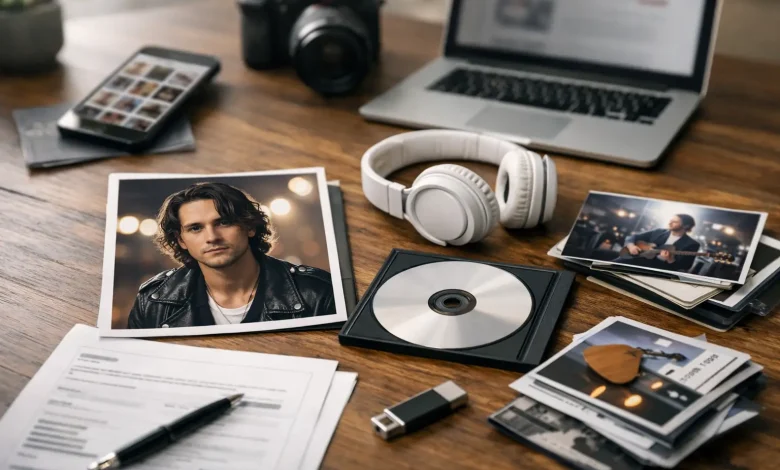
A strong song can open a door, but a disorganized email can close it just as fast. When you create an artist press kit, you are giving blogs, venue buyers, playlist curators, radio hosts, and potential collaborators a fast reason to care about your music and an easy way to cover it.
Your press kit is not a résumé stuffed with every milestone since your first upload. It is a focused promotional asset built to answer the questions industry people ask in seconds: Who are you? What does your music sound like? What are you promoting right now? Why should their audience pay attention?
What an artist press kit is really for
An electronic press kit, often called an EPK, is a shareable collection of your best artist information and media assets. It can live on a single clean webpage, in a well-organized cloud folder, or as a concise PDF paired with downloadable files. For most independent artists, a simple webpage or folder is easier to update than a static PDF.
The goal is not to impress someone with volume. The goal is to remove friction. A music blogger should be able to find your bio, newest release, photos, and social proof without asking for three follow-up emails. A promoter should be able to confirm your city, performance history, and contact details before moving to the next artist in their inbox.
The right format depends on the opportunity. A venue buyer may care most about your live footage and ticket pull. A curator may want a direct streaming link and a one-sentence angle for the release. A journalist needs accurate credits, images, and a story worth telling. One core kit can serve all three, as long as the essentials are easy to scan.
How to create an artist press kit with purpose
Start by deciding what your press kit needs to accomplish over the next 30 to 90 days. If you are pushing a new single, center the release. If you are booking a run of shows, lead with your performance identity. If you are building credibility for the first time, put your strongest music, clearest visuals, and most meaningful proof up front.
Trying to promote every song, video, and accomplishment at once makes the story weaker. Give people one current reason to engage, then let the rest of the kit support that reason.
Write a bio people can actually use
Your artist bio is the heart of the kit. It should sound like a person, not a list of genre tags and big claims. Open with your artist name, where you are based if it matters to your story, and the kind of music you make. Then explain the perspective, energy, or experience that makes the music distinct.
For example, saying you are a hip-hop artist from Atlanta is basic information. Saying your music turns late-night hustle, family pressure, and Southern bass into sharp, personal records gives an editor a usable angle.
Keep a short version around 50 to 75 words and a longer version around 150 to 250 words. The short bio is for quick captions and event listings. The longer bio gives writers enough material to shape a feature without inventing details.
Avoid claims you cannot back up, such as calling yourself the next biggest artist in the city. Confidence is valuable, but specificity earns more trust. Mention a real performance, notable placement, meaningful collaboration, local scene connection, or audience milestone only if it is accurate and current.
Put your best music front and center
Do not make the recipient hunt through a long list of links. Feature one priority release, then add two or three supporting tracks at most. Include the release title, release date, a brief description, and direct links to listen.
If the track has a story, share it in a sentence or two. Maybe it was produced during a tour, samples a family voice memo with permission, or marks a shift from melodic rap into Afrobeat-influenced songwriting. That context can turn a generic submission into a potential feature.
Use clean artwork and make sure every title, feature credit, producer credit, and spelling is correct. Details matter because press outlets often copy information directly from what you send. A typo in your own kit can end up on a flyer, blog post, or event page.
Make your visual identity easy to access
Your images should look like they belong to the same artist and campaign. Include at least one high-resolution portrait, one landscape image, and current cover art. If you have a music video, live performance clip, or visualizer that represents you well, add that too.
Do not overload the kit with 30 photos from different eras. Select a small group that matches your present release cycle. A photographer credit should be included whenever applicable, along with clear usage instructions if there are limits on where images can appear.
A downloadable asset section is especially useful when pitching press. Include these files in one clearly labeled location:
- High-resolution press photos in portrait and landscape formats
- Single, EP, or album artwork
- A logo or wordmark, if you use one consistently
- A one-sheet with release details, credits, and contact information
If a recipient has to request artwork after deciding to post about you, the momentum slows down. Make the easy yes even easier.
Show proof without turning the kit into a trophy case
Independent artists often feel pressure to fill a press kit with huge numbers. The truth is that credibility comes in different forms. A growing local fanbase, consistent live shows, a respected producer credit, community radio support, or strong engagement on a release can all matter.
Include proof that matches the person you are pitching. For a show promoter, add select past venues, festivals, opening slots, or live clips. For media and playlists, include prior coverage, meaningful listener data, or audience engagement. If you have earned press quotes, use one or two short, relevant lines rather than a wall of logos.
Numbers need context. Saying a video reached 50,000 views is more useful if it happened organically in a month or helped drive a sold-out hometown show. On the other hand, if your numbers are still building, do not manufacture momentum. Strong music, clear branding, and a professional pitch can get attention before the stats get massive.
Include the details people need to say yes
The bottom of every press kit should make action obvious. List a professional contact email, your manager or booking contact if you have one, and your primary social handles. Add your location and performance availability when booking is the focus.
For a release campaign, include the exact release date, genre, explicit-content status, key credits, and any time-sensitive news such as an upcoming video premiere. For live opportunities, include a short technical overview only if requested or genuinely useful. A full stage plot does not belong in every artist kit.
Before sending anything, test every file, image, and music link from a different device. Also check that permissions allow recipients to view or download what they need. The most polished kit in the world does not help if it opens with an access-denied message.
Keep your press kit current between releases
An EPK is a working asset, not a one-time school project. Update the featured music when your campaign changes. Replace outdated photos, remove old show dates, and refresh your bio when your sound or story evolves.
This is where many artists lose easy opportunities. They release a new single, run promo, gain new coverage, then keep sending a kit built around last year’s project. Your outreach should feel connected to the moment you are trying to create.
TuneBlast campaigns can help put a release in front of new listeners and music discovery audiences, but the artist press kit gives that attention somewhere professional to land. Promotion gets more valuable when every new contact can quickly understand your sound, story, and next move.
A great press kit will not replace strong records or consistent outreach. It will make both work harder. Build yours around the music you believe in most, keep it easy to use, and update it before the next opportunity arrives.
Ready to Promote Your Next Release?
If you're serious about getting your music in front of real listeners, we can help.